



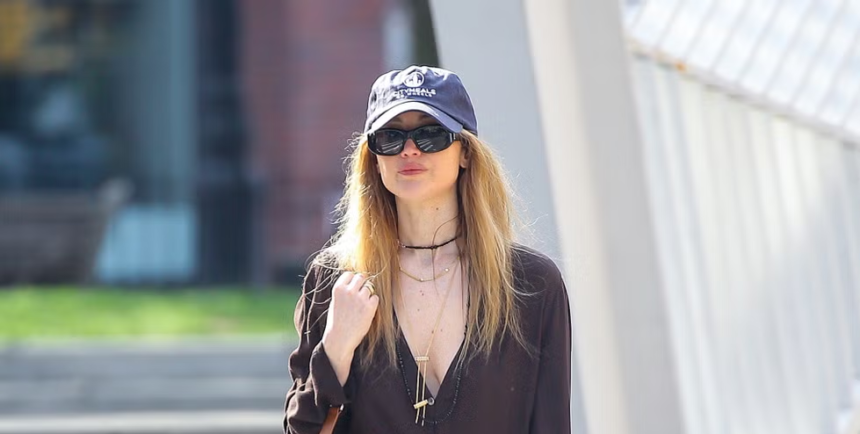
In the hierarchy of fashion footwear, flip-flops have historically occupied the lowest rung—functional, informal, and firmly associated with beachwear. But fashion cycles thrive on inversion, and in 2026, one of the most unexpected shifts is the elevation of this humble sandal into a luxury signifier. At the center of that shift is Jennifer Lawrence, who has once again demonstrated her ability to recalibrate everyday dressing.
Spotted in New York City, Lawrence delivered a look that, at first glance, reads as casual and even slightly chaotic. But on closer inspection, it reveals a tightly controlled styling framework—one where a single accessory, in this case a pair of flip-flops, becomes the gravitational center of the entire outfit.
The Flip-Flop Recontextualized
The focal point of the ensemble is Lawrence’s red-and-black thong sandals from The Row. Known for its minimalist ethos and high-quality materials, the brand plays a crucial role in reframing the perception of the shoe. These are not rubber beach flip-flops—they are leather, refined, and intentionally pared down.
This distinction matters. In luxury fashion, elevation often comes not from redesigning an item entirely, but from upgrading its materiality and context. By placing a traditionally “low-status” item within a high-fashion framework, the hierarchy itself is challenged.
Lawrence’s choice aligns with broader runway trends seen at houses like Balenciaga, Chanel, and Valentino, where casual footwear has been systematically reintroduced as a viable luxury staple.
Controlled Chaos: Mixing Without Clashing
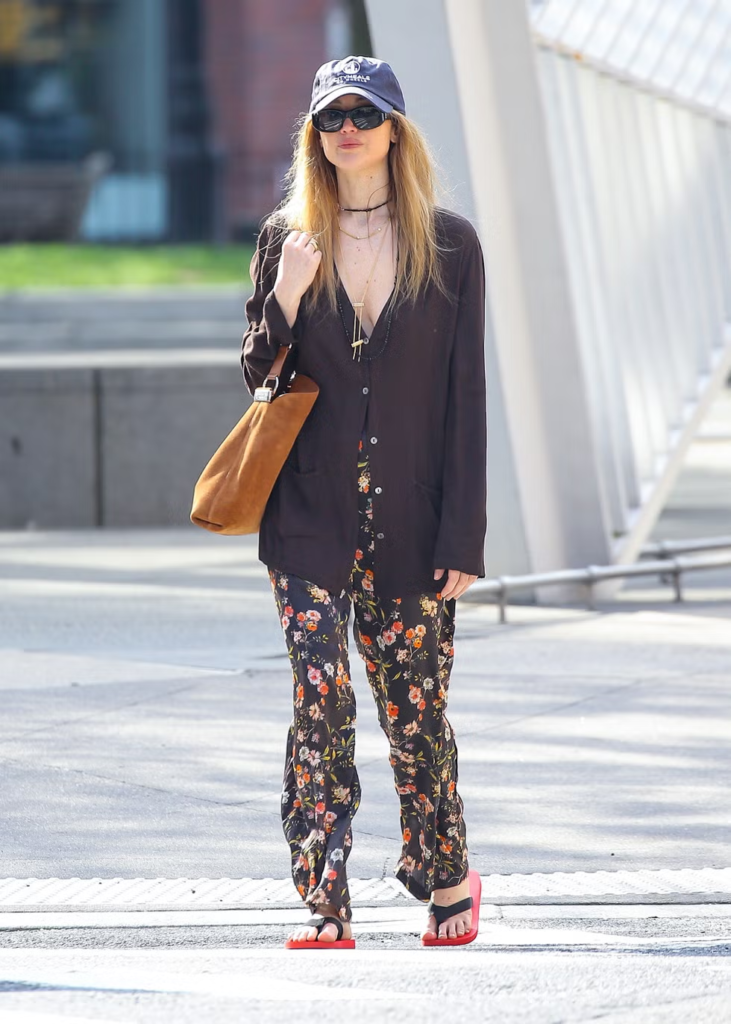
The rest of the outfit operates in what could be described as “controlled dissonance.” Floral-printed trousers introduce pattern density, while a loosely worn black button-up shirt adds movement and asymmetry through its partially undone styling.
This mix of elements—print, structure, and negative space—creates a layered visual field. On paper, it risks incoherence. In execution, however, it works because each component is anchored by a consistent tonal palette.
Accessories reinforce this balance. A suede Dior tote from Dior adds tactile richness, while layered rope necklaces in gold and black introduce vertical flow across the torso. These elements guide the eye downward—ultimately landing on the flip-flops.
The “Pop-of-Red” Mechanism
What truly integrates the look is Lawrence’s strategic use of red. The sandals are not an isolated accent; they function as a color anchor. Even in the absence of overt red elsewhere in the outfit, the hue resonates against the neutral and floral tones, creating a focal point that feels intentional rather than arbitrary.
This technique—often referred to as a “pop-of-color” strategy—is deceptively simple. Its effectiveness depends on restraint. Too many competing accents dilute the impact; too few, and the look risks feeling incomplete. Lawrence strikes the balance precisely.
Accessories as Cultural Markers
Her choice of a blue cap from Citymeals on Wheels adds another layer of meaning. As seen in her previous appearances, this accessory functions beyond aesthetics—it signals alignment with a cause, subtly embedding social awareness into an otherwise style-driven look.
Black sunglasses complete the ensemble, acting as a neutral buffer that stabilizes the visual complexity of the outfit.
The High-Low Equation
What Lawrence achieves here is a textbook example of high-low dressing:
- High: Dior tote, The Row sandals
- Low: Flip-flop silhouette, relaxed shirt styling
- Hybrid: Patterned trousers that sit between statement and casual
This interplay is what gives the outfit its modern relevance. Luxury is no longer about uniform elevation—it’s about contrast, juxtaposition, and context.
Why It Works
From a technical standpoint, the outfit succeeds because it adheres to three core principles:
- Single-point emphasis – The sandals act as the visual anchor.
- Palette control – Despite multiple elements, the colors remain cohesive.
- Textural variation – Suede, fabric, and leather create depth without excess.
These principles allow Lawrence to experiment without losing coherence—a balance that defines effective contemporary styling.
Conclusion
Jennifer Lawrence’s look is not about making flip-flops look expensive—it’s about redefining what “expensive” can mean. By integrating a traditionally casual item into a thoughtfully constructed outfit, she challenges the boundaries between luxury and everyday wear.
In doing so, she reinforces a key shift in modern fashion: status is no longer dictated solely by the item itself, but by how convincingly it is styled.
And in this case, a pair of flip-flops didn’t just complete the outfit—they defined it.
