



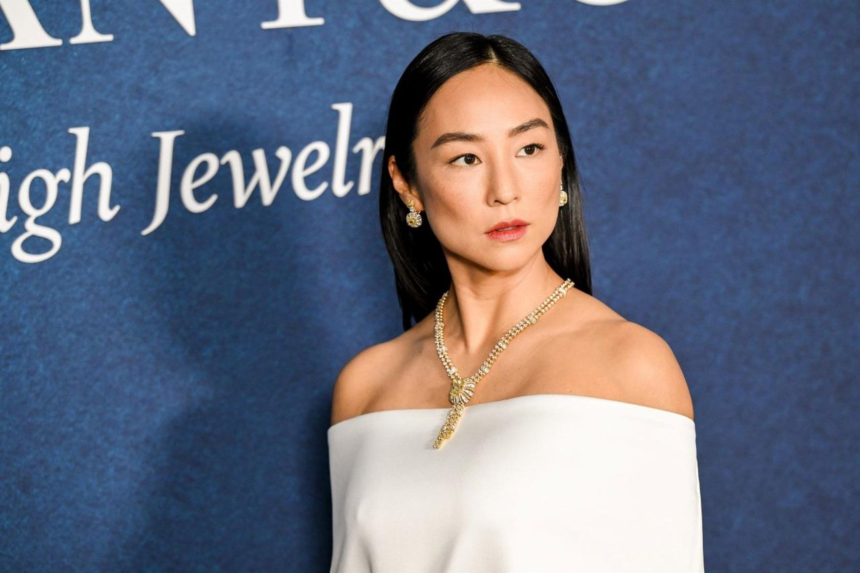
In contemporary red carpet dressing, maximalism is often misunderstood as excess without discipline. But Greta Lee’s appearance at the unveiling of Tiffany & Co.’s Blue Book 2026: Hidden Garden collection demonstrated something far more sophisticated: controlled opulence, where every visual element is calibrated for impact.
Held at the Park Avenue Armory, the event brought together a high-density concentration of fashion, celebrity, and luxury branding. Yet even within that environment, Lee’s look distinguished itself—not through sheer extravagance, but through compositional intelligence.
Reversing the Fashion Hierarchy
Lee’s outfit, drawn from Marc Jacobs Spring/Summer 2026 ready-to-wear, challenged a long-standing styling convention. Traditionally, red carpet looks follow a “top-down restraint” model—dramatic gowns paired with minimal accessories or vice versa. Lee inverted this formula.
Her ocean-blue sequined tube top carried the visual weight typically reserved for a full gown. Saturated in reflective texture, it introduced a disco-adjacent energy—playful, referential, and unapologetically bold. Yet instead of escalating that energy through equally loud styling across the entire silhouette, she grounded it with a black maxi skirt.
This contrast is critical. The skirt, while understated at first glance, featured structural nuance—particularly a widened waistband that subtly disrupted its minimalism. The result was a look that balanced spectacle with restraint, avoiding visual fatigue while maintaining interest.
Jewelry as the Primary Narrative Device
What ultimately elevated the ensemble, however, was Lee’s jewelry strategy. Rather than treating accessories as supplementary, she positioned them as the central narrative.
Her necklace—sourced from Tiffany’s Hidden Garden high jewelry collection—featured dual strands of jade-colored beads anchored by a prominent aquamarine centerpiece set in diamonds. From a design standpoint, this piece operates on multiple levels:
- Color theory: The green jade contrasts sharply with the blue sequins, creating chromatic tension rather than harmony. This deliberate clash amplifies visual interest.
- Material hierarchy: The scale and luminosity of the aquamarine stone establish a focal point that competes with, rather than recedes behind, the garment.
- Symbolic weight: Jade, historically associated with balance and prosperity, introduces a layer of cultural resonance that extends beyond aesthetics.
By pairing a statement top with an equally assertive necklace, Lee defied a conventional rule in styling: avoid competing focal points. Instead, she demonstrated that when executed with precision, dual emphasis can create a more dynamic visual field.
Footwear and Structural Cohesion
To stabilize the look, Lee opted for black patent-leather pumps from Gianvito Rossi. This choice is technically sound. The high-gloss finish subtly echoes the reflective quality of the sequins without introducing additional color variables.
Footwear, in this context, functions as an anchor—visually connecting the understated skirt with the high-impact upper half. It’s a reminder that even the most expressive outfits rely on foundational elements to maintain coherence.
Styling as Systems Thinking
Credit must also be given to stylist Danielle Goldberg, whose approach here reflects systems-level thinking. Rather than assembling isolated “statement pieces,” the look operates as an integrated composition:
- Texture (sequins vs. smooth fabric)
- Color (blue vs. jade green)
- Structure (fitted top vs. flowing skirt)
- Scale (garment vs. jewelry prominence)
Each variable is intentionally manipulated, resulting in a look that feels complex but not chaotic.
The Broader Shift Toward Intelligent Maximalism
Lee’s appearance signals a broader evolution in red carpet aesthetics. Maximalism is no longer about accumulation—it’s about orchestration. The goal is not to wear more, but to make each element work harder.
Events like Tiffany’s Blue Book launch amplify this shift. They are not merely social gatherings but curated environments where fashion and jewelry operate in dialogue. Attendees are, in effect, participants in a larger visual campaign—one that blurs the line between personal style and brand storytelling.
Conclusion
Greta Lee’s look succeeds because it understands a fundamental principle of modern fashion: impact comes from intention, not volume. By reversing traditional styling hierarchies and elevating jewelry to a central role, she delivered a masterclass in contemporary maximalism.
In a space where excess is common, precision stands out. And in this case, precision—rendered in sequins, jade, and aquamarine—proved far more compelling than spectacle alone.


