



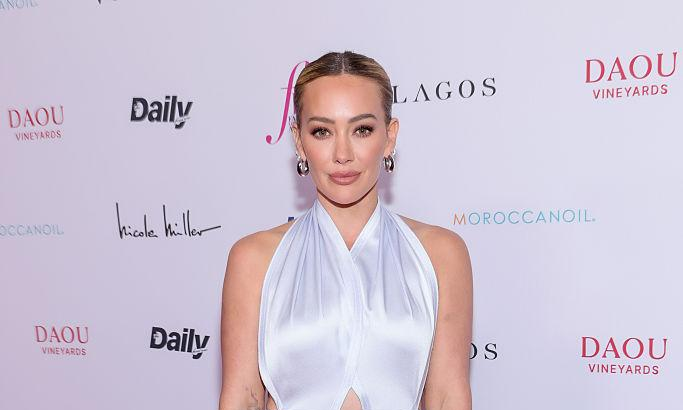
For many celebrities, transitioning from a well-known early-career identity into a fully realized, mature public image can be uneven. But Hilary Duff appears to have entered a phase where that evolution feels not only complete, but intentional. Her appearance at Fashion Los Angeles Awards offered a precise example of how style can reinforce personal and professional reinvention.
Fresh off the release of her sixth studio album Luck… or Something, Duff has been recalibrating her aesthetic—moving away from nostalgic associations and toward a more elevated, editorial presence. This shift was fully articulated in her choice of a two-tone gown from Victoria Beckham: a piece that balanced softness with structure, and classicism with subtle experimentation.
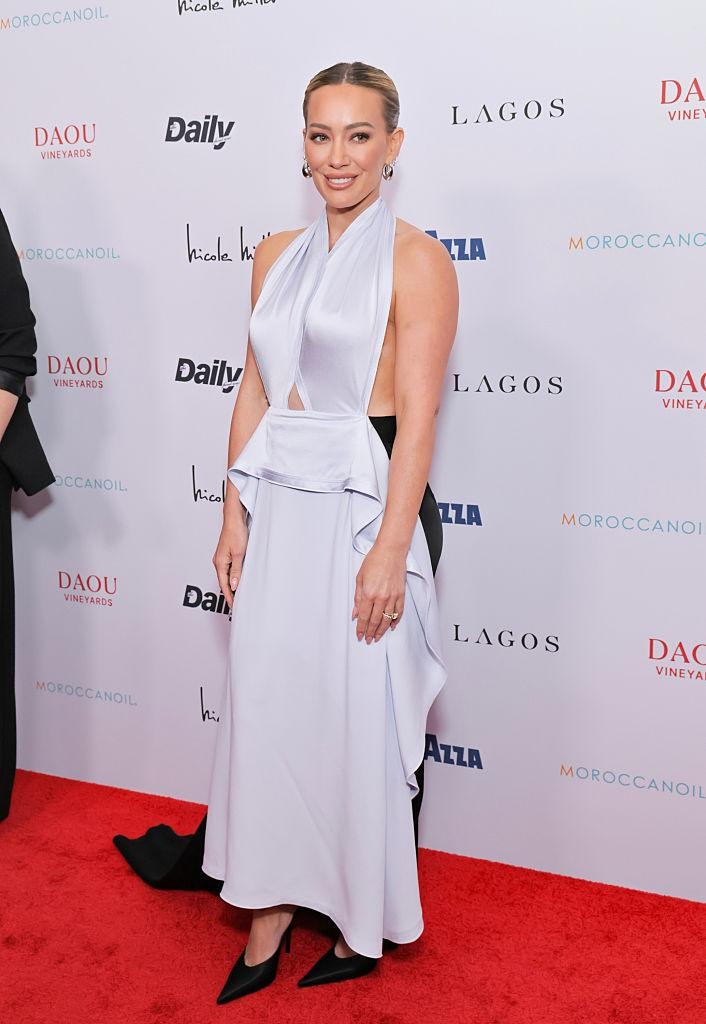
At first glance, the dress presents a clean, almost minimalist front. A metallic white halter construction drapes over the body with an apron-like silhouette—controlled, fluid, and highly polished. The bodice, formed by scarf-like bands tied at the neck, introduces a sense of delicacy while guiding the eye vertically.
But the design’s real sophistication lies in its contrast. As Duff turns, the garment reveals a black skirt extending into a subtle train—transforming the look from understated to dramatic. This front-to-back duality is a hallmark of contemporary design thinking: garments that evolve depending on perspective, rather than delivering a single, static impression.
The horizontal waist detail, cutting across the dress like a belt and cascading into scalloped edges, adds architectural complexity. It interrupts the vertical flow just enough to create dimension, preventing the silhouette from appearing overly linear.
Styling as Reinforcement, Not Competition
Duff’s styling choices demonstrate a disciplined restraint that aligns with the dress’s design logic. Black pointed-toe pumps echo the darker rear panel of the gown, creating continuity without drawing attention away from the garment itself.
Her jewelry—chunky silver hoop earrings—introduces a measured dose of boldness. Importantly, these accessories don’t attempt to compete with the dress’s structure. Instead, they operate as accents, reinforcing the overall composition.
This approach reflects a broader principle in advanced styling: when a garment carries conceptual weight, accessories should support rather than challenge it.
Beauty Direction and Cohesion
Equally aligned was Duff’s beauty direction. A soft pink lip, subtle blush, and coordinated eyeshadow created a tonal harmony that complemented the metallic sheen of the dress without overwhelming it. The choice of a tight bun further emphasized clarity—removing distractions and allowing the silhouette and neckline to remain the focal points.
In technical terms, this is low-noise styling: minimizing extraneous elements so that the primary design reads cleanly.
Contextual Significance
The setting itself—the Fashion Los Angeles Awards—adds another layer of meaning. Events like this are not merely social appearances; they function as industry-facing platforms where image, influence, and affiliation intersect.
Duff attended to honor her makeup artist, Kelsey Deenihan Fisher, but her presence also reinforced her own positioning within the fashion and beauty ecosystem. By choosing a designer like Victoria Beckham, known for precision tailoring and modern femininity, Duff aligned herself with a brand identity that mirrors her current trajectory.
From Nostalgia to Authority
It’s difficult to ignore the cultural subtext here. Duff’s early association with Lizzie McGuire remains a defining reference point for many audiences. But this look makes it clear that she is no longer navigating that legacy—she has moved beyond it.
The sophistication of the gown, combined with the restraint in styling, signals authority. It suggests a shift from being styled to actively shaping her image.
Conclusion
Hilary Duff’s appearance at the Fashion Los Angeles Awards was not about making a loud statement—it was about making a precise one. Through a carefully constructed balance of contrast, structure, and restraint, she demonstrated how modern elegance is less about excess and more about clarity.
In doing so, she offered a compelling example of what evolution in celebrity style can look like when it is fully realized: intentional, cohesive, and quietly powerful.


