



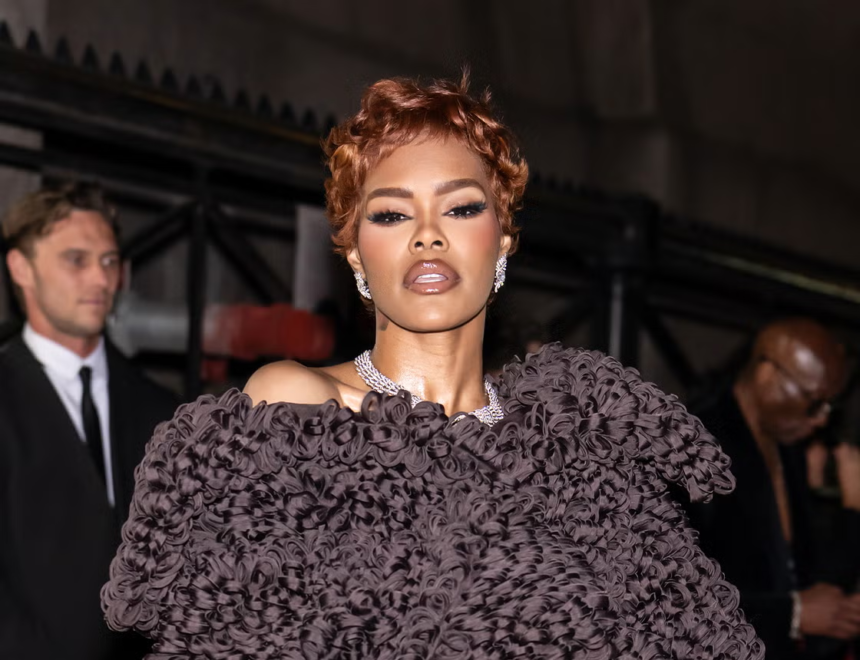
In most red carpet scenarios, environmental context—especially weather—acts as an unspoken constraint. Lightweight fabrics for summer, layered tailoring for winter. But Teyana Taylor has never operated within those predictable parameters. At the launch of Tiffany & Co.’s Blue Book 2026: Hidden Garden collection, she did something far more deliberate: she ignored the climate entirely.
On a New York evening pushing nearly 90°F (32°C), Taylor arrived at the Park Avenue Armory wrapped in a heavy, floor-length coat. Not despite the heat—but almost in defiance of it.
Dressing as Opposition
Taylor’s look, sourced from Calvin Klein Collection Fall/Winter 2025 under the direction of Veronica Leoni, wasn’t just seasonally inappropriate—it was conceptually oppositional.
The dark-chocolate organza coat featured a distinctive coiling structure, with looped detailing that created volume, texture, and movement. From a construction standpoint, this is a garment designed to occupy space. It doesn’t follow the body; it redefines it.
Worn with nothing underneath, the coat functioned as both garment and statement. This styling decision stripped away layering logic and reframed the piece as a standalone object—closer to wearable sculpture than traditional outerwear.
The Aesthetics of Discomfort
There’s a common assumption in fashion that comfort is either a priority or at least a consideration. Taylor’s appearance challenges that premise directly. By choosing a heavy coat in extreme heat, she foregrounded a different value system: visual dominance over physical ease.
This is not recklessness—it’s discipline. In high-fashion contexts, especially on red carpets, discomfort is often part of the equation. The difference here is that Taylor made that tension visible. The audience is aware of the contradiction, and that awareness becomes part of the spectacle.
In effect, she transformed climate into a narrative device.
Structural Echoes and Visual Cohesion
One of the more technically refined aspects of the look lies in its internal coherence. The loops of the coat mirrored the curls in Taylor’s short red hairstyle—a detail that might seem incidental but is, in fact, highly intentional.
This repetition of form creates rhythm within the outfit. It’s a principle borrowed from design theory: when shapes echo across different elements, the overall composition feels more unified.
Her choice of black pointed pumps further reinforced this structure. Minimal and sharp, they grounded the otherwise voluminous silhouette, preventing the look from becoming visually unbalanced.
Jewelry as Event Alignment
In alignment with the evening’s focus, Taylor accessorized with diamond pieces from Tiffany & Co. A princess-style necklace with a drop pendant and chandelier earrings introduced verticality and light reflection—key counterpoints to the matte, sculptural density of the coat.
From a styling perspective, this is a classic contrast strategy:
- Heavy vs. light (organza volume vs. diamond brilliance)
- Opaque vs. reflective (dark fabric vs. high-clarity stones)
- Mass vs. precision (broad silhouette vs. fine jewelry detailing)
The jewelry doesn’t compete with the coat—it punctuates it.
A Pattern of High-Risk Styling
This appearance is consistent with Taylor’s broader red carpet trajectory. Whether it’s a gemstone-embedded netted dress or a sculptural ensemble incorporating unconventional accessories, her approach resists moderation.
Importantly, these choices are not random. They follow a clear throughline: commitment. Each look is executed with full adherence to its internal logic, regardless of external conditions or expectations.
Red Carpet as Performance Space
What Taylor’s look ultimately underscores is the evolving function of the red carpet. It is no longer just a site of presentation—it is a stage for conceptual performance.
By rejecting seasonal appropriateness, she reframed the event from a passive showcase into an active statement. The coat becomes more than clothing; it becomes an argument about fashion’s autonomy from practicality.
Conclusion
Teyana Taylor’s appearance at the Tiffany & Co. Blue Book event wasn’t about dressing for the weather—it was about dressing for impact. In choosing a garment that contradicted its environment, she elevated styling into a form of narrative tension.
The result is a look that doesn’t just capture attention—it holds it, challenges it, and ultimately redefines what red carpet dressing can be.
In a landscape where many play it safe, Taylor continues to demonstrate that the most memorable fashion moments are often the least accommodating.


