



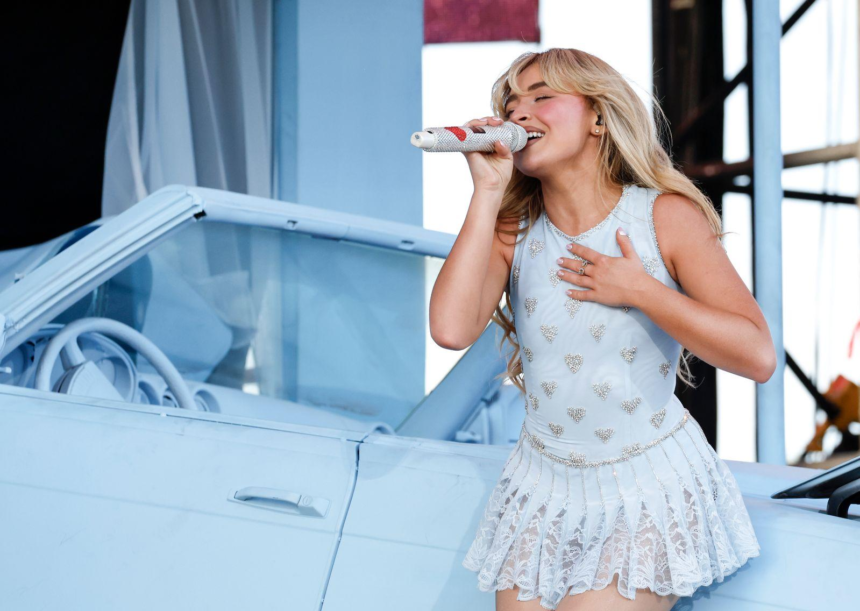
When Sabrina Carpenter took the stage for her second headlining set at Coachella 2026, expectations were already high. Known for her high-energy performances and carefully constructed visual identity, Carpenter had built a set designed for spectacle. But what unfolded midway through the night shifted the performance from impressive to historic.
Enter Madonna—a figure whose presence alone can recalibrate the cultural weight of any stage she steps onto.
A Moment Engineered for Impact
The surprise appearance wasn’t just a cameo; it was a tightly orchestrated intergenerational handoff. Together, Madonna and Carpenter performed “Vogue” and “Like a Prayer”—two tracks that are not just songs, but cultural artifacts. By placing them within a modern pop headliner’s set, the performance bridged decades of pop evolution in real time.
They didn’t stop there. The duo also previewed new material from Madonna’s upcoming project, Confessions on a Dance Floor: Part II, extending the moment beyond nostalgia into forward-looking relevance. This wasn’t a legacy act revisiting past glory—it was a strategic re-entry.
The Semiotics of Style
What elevated the performance from memorable to symbolic was Madonna’s wardrobe choice. She didn’t just reference her 2006 Coachella appearance—she recreated it. The same corset. The same boots. The same Gucci jacket.
From a fashion theory perspective, this is more than styling; it’s semiotics. Clothing becomes a signifier of time, memory, and identity. By wearing the exact pieces from two decades prior, Madonna collapsed the distance between past and present, creating what she herself described as a “full circle moment.”
The look—anchored by a purple corset layered over lace, paired with gloves and thigh-high stockings—retained its original DNA while gaining new meaning. In 2006, it represented reinvention during the Confessions on a Dance Floor era. In 2026, it symbolized continuity, endurance, and authorship over her own legacy.
Standing beside her, Carpenter’s white silk-and-lace bodysuit—custom-designed under Jonathan Anderson for Dior—offered a deliberate contrast. Where Madonna’s look was archival and referential, Carpenter’s was contemporary and forward-facing. Together, they formed a visual dialogue between eras.
Intergenerational Strategy, Not Coincidence
It’s tempting to read this collaboration as a spontaneous celebration of music, but that would miss the underlying strategy. Coachella has evolved into a platform where cultural capital is exchanged as much as it is displayed.
For Carpenter, sharing the stage with Madonna reinforces her positioning within the lineage of pop icons. It’s an implicit endorsement—one that signals durability and artistic legitimacy.
For Madonna, the appearance functions differently. It reasserts her relevance within a rapidly shifting industry landscape. By aligning herself with a current headliner, she avoids the stagnation that often accompanies legacy status.
This is not nostalgia for nostalgia’s sake. It is calculated continuity.
Music as a Unifying Narrative
Amid the spectacle, Madonna’s message to the audience cut through with notable clarity: music as a unifying force. Her statement—that music is a space where differences dissolve—may sound familiar, but in the context of this performance, it carried renewed weight.
Coachella itself has become a microcosm of global culture—diverse, fragmented, and hyper-visible. Moments like this performance function as temporary points of cohesion, where shared experience overrides individual difference.
The Business of Surprise
There’s also a structural dimension worth noting: the economics of surprise. Unannounced guest appearances have become one of Coachella’s most reliable mechanisms for generating viral reach. In an attention economy, unpredictability is currency.
Madonna’s entrance wasn’t just a creative decision—it was a distribution strategy. Within minutes, clips of the performance circulated across platforms, extending the lifespan of Carpenter’s set far beyond the festival grounds.
Legacy, Reframed
Ultimately, what made this moment resonate wasn’t just the performance itself, but what it represented. Madonna didn’t return to Coachella to relive the past; she returned to reinterpret it. By wearing the same outfit, performing the same songs, and introducing new material, she constructed a narrative of evolution rather than repetition.
Carpenter, in turn, demonstrated how contemporary artists can engage with legacy without being overshadowed by it.
Conclusion
In a festival defined by excess and immediacy, this collaboration stood out for its conceptual clarity. It was about time—how it moves, how it loops, and how it can be reshaped through performance.
Madonna and Sabrina Carpenter didn’t just share a stage; they created a moment where past and present coexisted with purpose. And in doing so, they reminded everyone watching that pop music, at its best, is not just entertainment—it’s continuity in motion.


